





The focus has shifted toward systems that respond to the business context in near real-time, learn from their own operation, and ensure agility without sacrificing quality or control.
The institution that takes this scenario seriously and builds the discipline of measurement, governance, and continuous testing necessary to respond to it with evidence will not only avoid the error that science has already documented.

It is a fact: we are moving through an era where artificial intelligence is reconfiguring how digital solutions are built, adapted, and scaled. The focus is now on systems that respond to business context in near real-time, learn from their own operations, and ensure agility without sacrificing quality or control.
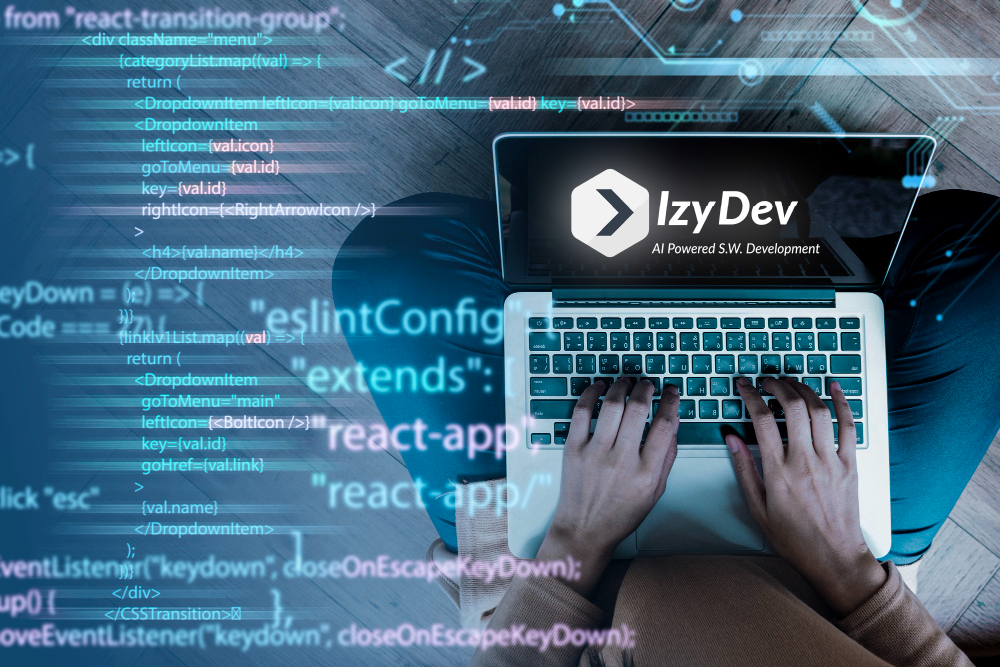
But beware: this revolution based on AI models, accelerators, and generative components also presents risks. Speed without governance can turn into chaos. Automation without QA becomes a vulnerability factor. And dependency on external solutions limits business evolution. This is where the concept of technological sovereignty arises, and where initiatives such as IzyDev, developed by Q-Vision Technologies, position themselves as true catalysts for intelligent transformation.
For decades, software development was a manual process where each of its phases—architecture, programming, testing—required direct human interaction. Now, tools like GitHub Copilot, CodeWhisperer, and LLMs are changing the rules of the game. According to Statista Tech Trends 2024:
55% of developers already use AI to generate code.
73% of technical decisions in medium and large companies will take into account their capacity for integration with artificial intelligence.
This transformation is not just technological. It involves moving from creating instructions to defining intentions—from "how it is done" to "what needs to be achieved." AI learns business patterns, generates solutions, tests them, and adjusts them. In this way, the developer becomes a systems orchestrator, not a task executor.
The greatest paradox in this evolution is that many organizations, in their rush to digitize quickly, adopted SaaS solutions that today limit their customization, control, and sovereignty. The initial promise of agility is transformed into a rigid architecture that prevents responding to new market conditions.
Initiatives like IzyDev break this logic. They combine artificial intelligence to generate functional components with a governance layer that allows organizations to maintain architectural, functional, and operational control over the developed software. The result? A technology stack that learns, adapts, and evolves according to business needs.
Instead of relying on third parties, internal teams can:
Create adaptive platforms that react to business events.
Keep operational logic under their control.
Break the cycle of technological dependency and reclaim sovereignty.
The idea that faster is always better has been the Achilles' heel of many digital transformation projects. According to an Accenture study (2024), 68% of CIOs and CTOs reported functional errors or performance failures in solutions that used AI without adequate human supervision. Acceleration without intelligent QA or version control can lead to catastrophic failures.
The true value of AI in development lies in its integration with:
Controlled CI/CD flows, where every change passes through automated validation stages.
Human review protocols for strategic decisions or critical modules.
AI Governance tools that audit performance, legal compliance, and the traceability of algorithmic decisions.
Robust software today is that which adapts safely, complies with regulations, scales sustainably, and respects the business's ethical boundaries.
This new paradigm also transforms the profile of the talent driving technology. The market no longer needs simple programmers; it requires professionals capable of designing workflows between autonomous systems, connecting business rules with AI-driven decision engines, and maintaining "living" infrastructures that constantly adjust.
It is not about how many stacks a person knows, but rather their ability to:
Design intelligent ecosystems where AI executes repetitive tasks and humans make critical decisions.
Manage architectures that update automatically based on business conditions.
Implement dynamic security, review, and control policies without hindering agility.
The future of software development is already underway. Artificial intelligence will accelerate cycles, but the true differentiator will be an organization's ability to design intelligent, governable structures aligned with their business logic.
To maximize this transformation, it is recommended to:
Implement frameworks that integrate Generative AI, Intelligent QA, and AI Governance tools from the very conception of products.
Invest in talent that understands adaptive architecture rather than just individual frameworks.
Foster technological independence through solutions like IzyDev, which combines agility and intelligence with control and customization.
Establish KPIs that are not only technical but also related to traceability, ethics, and operational sustainability.
Define continuous review cycles where the primary focus is the software’s evolutionary capacity, not just its delivery.
Software reconstruction is not a technical change; it is a profound redesign of technology's role in business. Having software that evolves with your organization—under control, with context, and quality—is indeed a competitive advantage.
In that direction, IzyDev marks a clear path for those who believe that AI empowers, but does not replace, strategic thinking.
Puedes configurar tu navegador para aceptar o rechazar cookies en cualquier momento. Si decides bloquear las cookies de Google Analytics, la recopilación de datos de navegación se verá limitada. Más información.