






In the new landscape of higher education, the key is not just reaching prospects; it is interacting with them at the precise moment, with the right information, and through the appropriate channel.
The future of development is unlikely to be fully autonomous. Instead, it will be hybrid. Organizations that understand how to blend human and artificial intelligence will define technological leadership in the coming decade.

Higher education in Latin America is entering a critical stage. Fewer students, more demanding, with less patience and higher expectations. How should institutions respond? The demographic shift is not a distant theory: in Colombia, between 2025 and 2035, DANE projects a reduction of more than 88,000 young people in the traditional age range for entering university. This means a smaller candidate pool and much more intense competition.
But the challenge doesn't end there. New generations no longer just expect universities to instruct them; they expect them to serve them. They demand agile responses, seamless experiences, and personalized attention from the first click. In this landscape, every lead is gold, and operational efficiency supported by automation, artificial intelligence, and intelligent interactions becomes a requirement for survival.
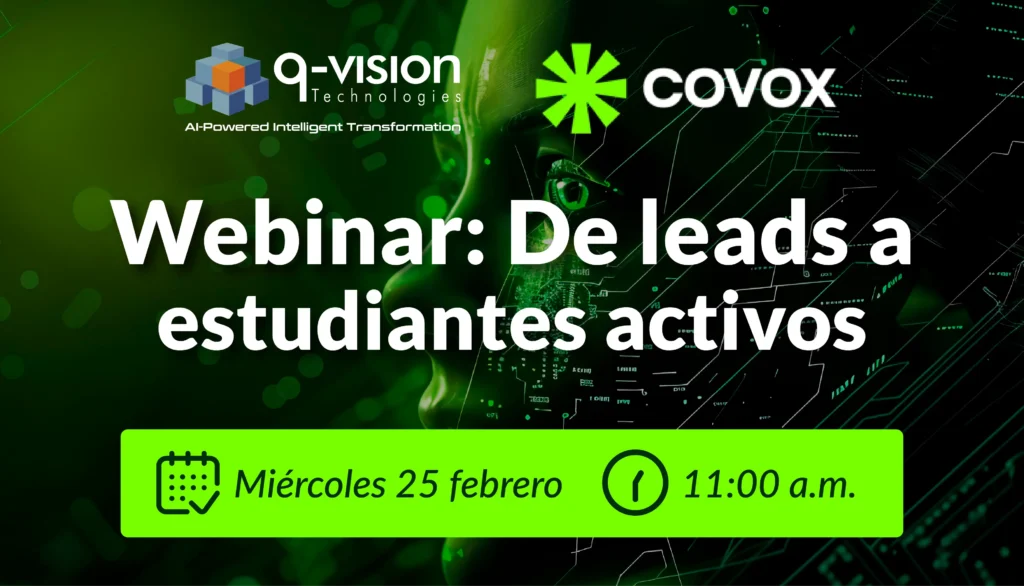
Discover this February 25th at 11 a.m. how to design an operation that supports growth without being held back by human limits. Register here: https://qvision.fillout.com/covox-webinar
The pressure facing Higher Education Institutions (HEIs) is not only demographic but also operational. A quick look at regional market indicators is enough to grasp the scale of the challenge:
Low Conversion Rates: The average conversion rate for higher education in Latin America is barely 2.8%, according to SEMrush. This implies that over 97% of potential students are lost along the way.
Incomplete Enrollments: In Colombia, only 18% of enrollment forms started at private universities are successfully completed, according to ExpertoEdu and Datapop (2023).
The "Speed of Trust": According to HolonIQ, 67% of students consider not enrolling if they do not receive a response from the institution within the first 24 hours after showing interest.
Manual Dependency: Beyond student perception, 52% of Latin American universities admit that their enrollment and admission processes still rely heavily on manual tasks (QS Intelligence Unit, 2023).
This context reveals a serious dissonance between the expectations of future students and the operational capabilities of many universities. In that gap, institutions lose not only revenue opportunities but, more importantly, long-term relationships.
With a more informed and scattered audience, capturing digital interest must be immediate and relevant. Generic campaigns no longer generate traction, and one-way journeys are losing effectiveness. HEIs must transform their digital channels into living spaces where they listen, respond, and provide guidance in real-time.
Dynamic segmentation, behavioral remarketing, and messaging adapted to the lead's lifecycle are essential practices to compete in the micro-decision: that window of seconds where a young person decides to either leave their data or close the tab.
A lead does not convert on its own. It needs guidance, certainty, and immediate answers. Today, one of the most powerful differentiators in the enrollment decision occurs between the form and the registration payment. Who provides agile support? Who resolves technical doubts with empathy? Who reminds them of the next step at the right moment?
This is where conversational solutions, such as those developed by Covox, make a substantial difference. Agents designed to interact sensitively and contextually allow for active conversations with thousands of leads simultaneously without overwhelming admissions departments.
Discover this February 25th at 11 a.m. how to design an operation that supports growth without depending on human limits.
Register here: https://qvision.fillout.com/covox-webinar
An emerging trend among innovative institutions is moving away from the funnel metaphor to adopt the flywheel. In other words: stop seeing the lead as a momentary conversion and start building relationships before enrollment.
This involves generating high-value content, designing memorable digital experiences, maintaining constant and automated (yet empathetic) interaction, and activating post-registration channels. Universities that have adopted this logic have increased their conversion rates by up to 40% compared to historical figures by combining digital strategy with conversational automation tools.
It is not a choice between efficiency and closeness. On the contrary, automating reminders, standardized follow-ups, and FAQs frees up human time for what cannot be delegated: understanding the student's context, guiding their decisions, and building trust.
Universities redesigning their processes understand that we cannot treat all leads as if they were the same. But to do it right, you must first automate the repeatable. Only then is it viable to scale support without compromising the experience.
Q-Vision Technologies, with its extensive experience in digital transformation and automation across critical sectors, has partnered with Covox, a leader in conversational intelligence solutions, to offer a comprehensive proposal for the educational ecosystem.
This alliance addresses the challenge from three key fronts:
Automation of Engagement Processes: Implementing multi-channel interactions to ensure no inquiry goes unanswered.
Predictive Intent and Churn Models: Powered by artificial intelligence to identify which prospects are most likely to enroll and which are at risk of dropping off.
Real-Time Dashboards and Tools: Empowering teams to intervene at the exact moment and place where they can make a real difference.
Next Wednesday, February 25th, leaders in operations, admissions, enrollment, and marketing are invited to discover how these solutions are changing the way universities across the region work, scale, and build loyalty.
Register here: https://qvision.fillout.com/covox-webinar
The demographic contraction is not a temporary dip; it is a structural shift. The sustainability of universities no longer depends solely on their prestige or history, but on their ability to adapt to new student profiles, new decision-making rhythms, and new service demands.
What is the path forward?
Constant Measurement: Monitor response times at every stage of the student journey.
Conversational Integration: Implement tools that anticipate and activate: prioritizing what is urgent, what is relevant, and what is human.
Lead Redefinition: View each lead not just as a commercial opportunity, but as an individual in the process of making a life-changing decision.
New Success Metrics: Focus on activated leads, supported leads, and converted leads.
In the new landscape of higher education, the key is not just reaching prospects; it is interacting with them at the precise moment, with the right information, and through the appropriate channel. Every conversation has the potential to be the next one that converts.
Puedes configurar tu navegador para aceptar o rechazar cookies en cualquier momento. Si decides bloquear las cookies de Google Analytics, la recopilación de datos de navegación se verá limitada. Más información.