





On October 20 in Orlando, Gartner presented its top ten strategic technology trends for 2027. Six of them directly touch the three core capabilities of our portfolio. This is our perspective—from the teams doing the work every day.

On October 6, the World Bank. On October 20, ECLAC and Chile’s National Center for AI. Two distinct assessments reached the exact same conclusion: the bottleneck lies not in the tool itself, but in the organizational capacity to absorb it. An academic concept originating in 1990 brings order to what today’s numbers describe.
The challenge is not merely implementing AI agents. It is knowing precisely which ones are running, who bears accountability for them, how their outputs are validated, and how swiftly they can be shut down when something fails.
Applying agentic AI to payments requires the exact same level of rigor as any system handling third-party funds—extended to a type of actor that did not exist two years ago: one that decides and executes, rather than merely recommends.

Gene Alvarez, Distinguished VP Analyst at Gartner, opened the presentation with a diagnosis that any technology team will recognize. AI systems, he noted, operate within an architectural void: they generate software faster than human teams can review it, expose credential pathways that remain unmanaged, and leave critical processes tightly bound to a single vendor. He urged technology leaders to shift from passively observing model performance to actively designing the operational boundaries separating the organization, human professionals, and machines.
The list encompasses ten strategic trends: Large Quantitative Models, Speech Reasoning Models, World Models, AI Context Platforms, AI Coding Agent Harnesses, AI Agent Identity, Autonomous Exposure Remediation, SovereignTech, Disposable Applications, and Wetware as a Service. Gartner groups these into three core themes, with four trends—those residing in the governance block—specifically focused on constraining what autonomous agents can see, access, and execute.
We examined the list through a practical lens: which of these trends are already embedded in our day-to-day operations? The answer is six. We explore them in the order we experience them in practice.
Gartner defines the AI coding agent harness as a closed-loop control system that governs agents throughout the entire software development lifecycle. It integrates development platforms with enterprise context, model routing, verification gates, and feedback loops. Without this foundation, developers end up manually inspecting machine-generated output, evaporating any real productivity gains. Alvarez added that developers must own and lead the harness—since it relies directly on their domain knowledge—and that organizations should treat it as an evolving asset that continuously learns.
Within our engineering teams, this aligns with a familiar practice: continuous regression. Mauricio Buitrago, who leads our test automation practice, explained it recently during a panel with our testing leaders: regression testing no longer runs right before a deployment window. It runs dynamically inside the pipeline on every single change—executing a critical subset in minutes and offloading the remainder in parallel, completely free of human intervention.
To make this sustainable, the test suite must achieve extreme reliability. A test that fails due to environmental noise and forces a developer to troubleshoot it manually is useless in a non-stop delivery pipeline. This is why our teams leverage self-healing AI tooling: when a non-critical element changes, the execution script self-adjusts on the fly, keeping the team focused exclusively on legitimate failures.
Freddy Silva, who heads functional testing, highlighted the crucial human dimension. AI assists in synthesizing complex test scenarios directly from functional requirements, which our engineers then review, refine, and validate before execution.
Carol Ortega, our performance testing lead, shared how we consistently stress-test client architectures to their absolute limits using volumetric and endurance testing—because operational traffic spikes no longer follow historical patterns, rendering traditional average-based planning obsolete.
It was Carol who framed the core principle our teams reinforce across every engagement: testing suites and production dashboards must track identical telemetry metrics. A verification gate that mirrors real-world production conditions earns team trust; one that doesn't is quickly bypassed.
Gartner estimates that by 2028, 25% of enterprise security breaches will originate from the abuse of AI agents, driven by unmanaged machine privileges and legacy credential management practices. The firm further warns that without resolving identity management, more than half of enterprise AI initiatives could come to a standstill. Gartner's proposed remedy is to bind every model, prompt instruction, and credential directly to the agent's executed actions, replacing high-risk static credentials with dynamic, runtime access controls. This market forecast has been circulating since 2025.
Regional data validated this threat vector just this week: cybersecurity firm IQSEC documented 101 data leaks and 116 compromised entities across Mexico over a seven-week period in the first half of the year, spanning 26 public institutions and 11 distinct economic sectors.
Within our portfolio, our Agent Talent framework builds on the exact premise Gartner places at the center of this trend: an AI agent enters an operational team with a explicit role, a defined scope of authority, and a designated human manager held accountable for its work. This reflects the same onboarding protocol applied to any human colleague—defining responsibilities, data access rights, and escalation chains.
From a DevSecOps standpoint, we execute this through identical principles: dynamic short-lived credentials, least-privilege scoping, and complete end-to-end auditability of every programmatic action. Gartner pairs this with Autonomous Exposure Remediation—systems designed to discover vulnerabilities, validate patches, and deploy fixes autonomously into production. Yet, for any system modification impacting critical business infrastructure, our operational stance remains firm: every autonomous patch deployment requires a human in the loop.
AI Context Platforms centralize an organization's fragmented knowledge, providing agents with the domain context required to interpret incoming data and execute aligned with business objectives. Gartner projects that by 2027, organizations prioritizing semantics in their AI-ready data layers will increase agentic AI accuracy by up to 80% and reduce operational costs by up to 60%.
An agent's response is only as good as the context it receives, and the quality of that context depends directly on who structured the data, under what criteria, and with what operational oversight. This is the explicit function of the Autonomous Data Stack.
In Colombia, the Colombia AI Pulse 2026 study by Endeavor Data Unit—surveying 493 professionals—revealed that while 61% view AI as a strategic priority, only 37.7% have meaningfully integrated it into their operations. Closing that adoption gap relies largely on structured data that human experts have taken the time to truly understand.
Alvarez spoke about transitioning into active architects of the boundaries between the human and the mechanical. Within our portfolio blueprint, the phrase encircling every single capability is Human-in-the-loop—and we placed it there with deliberate intent.
Carol summarizes this reality better than anyone: what the industry urgently requires are analysts who know how to interpret the numbers delivered by a test suite and translate them into actual business risk. AI generates raw information, but a professional with real domain judgment must ground those insights in the specific operational context of the client. That strategic interpretation, she notes, remains extremely scarce.
Regional benchmarks confirm this bottleneck. In the Fedesoft and Cenisoft survey of Colombian technology companies published on October 7, 46% of organizations identified the lack of specialized talent as the single largest barrier to adopting AI agents.
This is precisely why our three core capabilities can only be fully understood when operated together:
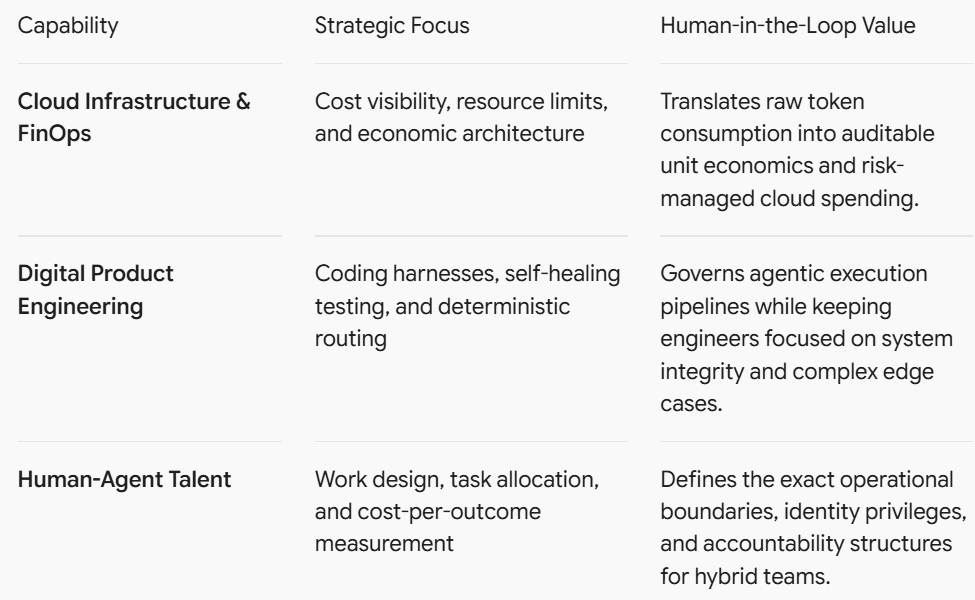
Read from our perspective, Gartner’s list leaves one clear constant: almost every trend impacting our work demands a professional with sound judgment by its side—someone to review, someone to assume accountability, someone to translate insights into business context. That is precisely how we build our hybrid human-agent teams: with a clear operational scope for each side and outcomes that can be audited and measured.
Puedes configurar tu navegador para aceptar o rechazar cookies en cualquier momento. Si decides bloquear las cookies de Google Analytics, la recopilación de datos de navegación se verá limitada. Más información.