






Artificial intelligence (AI) has emerged as a disruptive force across various industries, and software testing is no exception. As applications become more complex and the demand for quality increases, traditional testing methods face significant challenges.

The challenge is not merely implementing AI agents. It is knowing precisely which ones are running, who bears accountability for them, how their outputs are validated, and how swiftly they can be shut down when something fails.
Applying agentic AI to payments requires the exact same level of rigor as any system handling third-party funds—extended to a type of actor that did not exist two years ago: one that decides and executes, rather than merely recommends.
The institution that takes this scenario seriously and builds the discipline of measurement, governance, and continuous testing necessary to respond to it with evidence will not only avoid the error that science has already documented.
In this context, AI offers a promising solution but also presents new hurdles. In this article, we critically analyze how AI is transforming software testing, exploring its benefits, tools, real-world use cases, and challenges.
Software testing is a fundamental process in application development, aimed at identifying and correcting errors before the product reaches end-users. Software quality not only impacts customer satisfaction but can also have legal and financial implications. Therefore, ensuring thorough testing is crucial for the success of any development project.

Artificial intelligence (AI) has emerged as a disruptive force in software testing. As applications grow more complex and the demand for quality rises, traditional testing techniques are encountering significant obstacles.
The 2024 State of Software Quality Report, published by Katalon, provides valuable insights into current trends and challenges in software quality. Based on a global survey of 3,800 professionals and interviews with 14 experts, the report highlights the innovations and practices shaping the industry. One of these trends is AI in software testing, leveraging advanced algorithms and machine learning to enhance and automate the testing process, thus addressing the needs of a rapidly evolving field.
According to QAlified’s blog on software testing trends for 2024, some of the most prominent benefits of implementing AI in testing include:
A recent study by Capgemini showed that companies adopting AI in their testing processes reduced testing time by 30%. For example, a fintech company implemented Testim and cut its testing time by 40%, allowing developers to focus on innovation rather than fixing bugs.
In response to the future challenges of testing, Q-Vision has developed its own AI-driven tool called IzyTesting for a comprehensive software quality assurance process, illustrating AI’s positive impact on software testing.
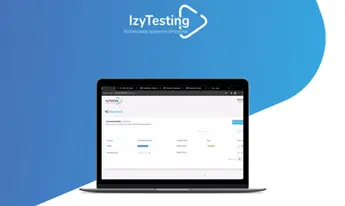
IzyTesting can interpret functional requirements and convert them into test cases, plan the software testing process, design test cases, execute sprint tests, and evaluate results with an analysis that adds value to the product. Among its current features:
These capabilities, along with others in development, promise clients an optimized testing process, greater accuracy and efficiency, and higher-quality products delivered in less time.
Artificial intelligence is undoubtedly revolutionizing software testing by providing significant benefits in efficiency and precision. However, challenges such as the learning curve, cost, and integration must be carefully considered to maximize AI’s value in testing. By addressing these obstacles proactively and positively, organizations can take full advantage of AI and elevate software quality to new heights.
Ready to take your company to the next level? Contact us today to discover how our services and tools can transform your business. Let’s talk about your ideas and bring them to life!
Author:
Amanda Espinosa,
Knowledge Manager
Innovation and Development
Puedes configurar tu navegador para aceptar o rechazar cookies en cualquier momento. Si decides bloquear las cookies de Google Analytics, la recopilación de datos de navegación se verá limitada. Más información.