






Latin America’s demographic crisis is not a distant threat. It is a reality that is already closing schools, shrinking enrollment numbers, and redefining which institutions actually have a future.


The birth rate crisis is emptying classrooms across Colombia and Latin America. The institutions that survive will be those that turn student scarcity into a competitive advantage rooted in personalization, responsiveness, and artificial intelligence.
01 THE REAL THREAT
There are figures that leave no room for an optimistic interpretation. In 2024, Colombia recorded only 453,901 births—the lowest number in over a decade and a 12% drop from the previous year. Compared to the 656,704 births in 2017, this decline represents nearly a one-third loss of the population expected to enter the educational system in the coming years.
This is not a temporary economic cycle; it is a structural transformation. The fertility rate plummeted from 2.5 children per woman in 2000 to 1.6 in 2024, falling well below the generational replacement level of 2.1. Between 2020 and 2024 alone, 800,000 fewer children were born than projected. This cumulative deficit cannot be recovered.
The impact is already visible: 6,263 educational branches have closed in Colombia over the last six years, 39% of which were private. In 2023, enrollment in preschool, primary, and secondary education fell to 9.5 million—its lowest level in years. This cascading effect is only beginning: the children not born today are the missing university students of 2040.
Bogotá could lose more than 100 private and 90 public schools before 2035. The combined impact of the pandemic and the post-2017 birth rate drop is already putting severe pressure on enrollment.
UNESCO projects that by 2030, there will be 11.5 million fewer school-aged children and adolescents compared to 2020 across the region. In 14 Latin American countries, enrollment will drop by more than 5%.
The population aged 17 to 21 will begin to contract sharply. The system will lose approximately 88,000 university-aged youths during this period alone.
Projections from EAFIT University estimate that Colombia will have ~500,000 fewer youths in the university age bracket, dropping from 3.9 million to 3.4 million potential students.
02 THE REGIONAL OUTLOOK
The UN 2025 Demographic Observatory confirmed that 76% of countries in Latin America and the Caribbean now record fertility rates below the level required to maintain a stable population without migration. Mexico, Brazil, Argentina, and Colombia are leading this trend.
In the U.S. higher education market, this phenomenon already has a name: the "Enrollment Cliff." A 15% drop in the number of college students is projected between 2025 and 2029. Mid-sized private institutions are the most vulnerable, with their closure rate doubling over the last five years. The difference is that LATAM will hit this same wall with significantly less time to prepare.
"These demographic shifts are not peripheral. They represent a fundamental break from decades of educational planning built on expansion." — UNESCO, Demographic Observatory 2025
Higher education coverage in Colombia reached 57.53% in 2024, but this stagnation is occurring even before the heaviest demographic blow hits the sector. Between 2010 and 2021, Colombian private universities had already lost 65,000 students—and that was during a time of relative growth. What lies ahead is of a different order of magnitude.
03 THE STRATEGIC LOGIC
When the prospect pool shrinks, the conversion of every single lead becomes exponentially more valuable. You can no longer afford to lose a potential student due to slow response times, indifference, or a lack of personalization. Every admissions interaction counts. Every minute of delay can cost a university tens of millions of pesos in lost tuition per year.
Today, the lead response cycle in most Latin American universities follows a predictable, yet flawed, pattern: a prospect sees an ad on Instagram or Google for an MBA or a Master’s degree, they click, fill out a form—and then they wait.
The Average Response Time in LATAM: Over 24 hours for specialized programs. For many universities, the actual time exceeds 2 days. Meanwhile, the Meta or Google algorithm has already served the prospect ads from 5, 8, or 12 competing institutions.
"Speed has become an overwhelmingly critical factor. The algorithm doesn't wait. Neither does the student."
04 THE COMPETITIVE ADVANTAGE
The Modern Learner Report 2025 reveals that 58% of students begin their search by looking for institutions rather than specific programs. The institution that manages to forge a personalized connection from the very first touchpoint gains a significant conversion advantage. In a market with 500,000 fewer students, a generic value proposition is professional suicide. Individual relevance is the only currency that matters.
The disparity between institutional reality and market expectations is staggering:
Average institutional response time in LATAM: Over 24 hours.
Optimal contact window for an educational lead: Less than 5 minutes from the initial interaction.
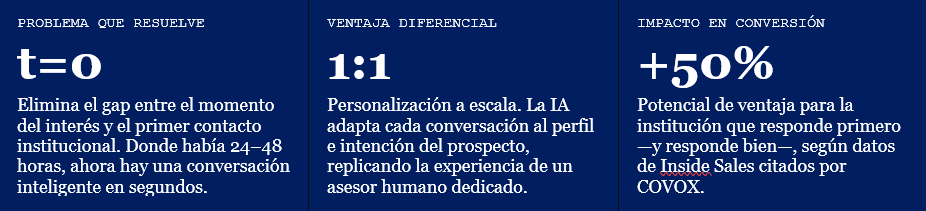
Conversion advantage of responding first vs. later: Up to 50% higher (per Inside Sales data).
The algorithm redistributes student interest in real-time. Every hour of delay is effectively gifting market share to your competitors.
The first contact is just the beginning. The value ladder—from initial interest to final enrollment—requires continuous, frictionless support. Institutions with the highest conversion rates maintain active follow-ups throughout the student’s entire decision-making cycle, ensuring the prospect never feels abandoned in the "information void."
05 THE TOOL
COVOX is a conversational intelligence platform for educational institutions currently operating in Spain, Colombia, and Mexico, with active expansion into Peru and the United States. It directly addresses the most costly and least visible problem in the admissions funnel: the "dead time" between lead generation and first human contact. By leveraging AI-driven conversational automation, COVOX ensures that whenever a prospect interacts with a digital ad, they receive an immediate, personalized response designed to move them seamlessly toward enrollment.
The implementation model includes a 20-day fine-tuning period, team training on lead management best practices, and an intensive post-implementation support phase. Our diagnostic methodology—which begins with active listening questions to demonstrate a deep understanding of your context before presenting the solution—is precisely the type of consultative selling that builds trust within the educational sector.
"If you had this up and running for the next academic cycle, do you believe your results would improve and you would see higher enrollment numbers?"
06 THE INVESTMENT THESIS
There is a counterintuitive paradox at play: while the crisis contracts the market, it simultaneously increases the value of every student captured. Consequently, the potential return on any technology that improves conversion rates rises exponentially.
Consider a mid-sized Colombian university with 3,000 active students and an average tuition of $8 million COP per semester. This institution generates approximately $48 billion COP in annual revenue.
If the university loses just 10% of its prospects due to poor response times—a conservative estimate—it is effectively leaving $4.8 billion COP on the table every year. Implementing a tool that improves that conversion by a mere 15% yields an additional $7.2 billion COP in annual revenue.
Latin America's demographic crisis is not a distant threat. It is a reality that is already closing schools, shrinking enrollment, and redefining which institutions have a future. The good news is that the window for adaptation is still open.
The institutions that survive will be those that understand that in a market of scarcity, the prospect’s experience—from the very first second of contact—is their most powerful differentiator. Tools like COVOX do not exist to replace human admissions talent; they exist to amplify it, ensuring that no lead is lost in the silence between the click and the call.
At the edge of the demographic cliff, technology is not merely a modernization option. It is the defining factor between existing in 2035 or becoming a memory.
SOURCES
DANE – Vital Statistics Colombia 2024.
UNESCO / IIEP, Declining birth rates and the new challenge of educational planning in Latin America, Nov. 2025.
Inside Sales Institute, Speed to Lead Study.
BBVA Research, Fertility in Colombia 2024.
Education Economics Lab, Universidad Javeriana.
Universidad EAFIT, Enrollment Projections for Colombia.
EducationDynamics, 2025 Landscape of Higher Education.
Product Evaluation Transcript, COVOX / Q-Vision, 2026.
Las2orillas.co, "The birth crisis ends the business of private schools," March 2026.
Puedes configurar tu navegador para aceptar o rechazar cookies en cualquier momento. Si decides bloquear las cookies de Google Analytics, la recopilación de datos de navegación se verá limitada. Más información.